At Sajjad Rehabilitation & Therapy Centre in Patna, we help children who are late to talk, use very few words, or find it hard to understand and express language. Our therapy plans are made to improve daily communication in a simple and practical way.
The child may start using words later than expected or may speak much less than other children of the same age.
Some children know only a small number of words and find it hard to grow their vocabulary.
The child may say single words but find it hard to make short phrases or simple sentences.
The child may not understand simple instructions, questions, or common everyday words.
The child may get upset because it is hard to ask for help, food, toys, or comfort with words.
Some children understand part of a question but cannot answer clearly or give the right words back.
We first check how the child understands words, follows directions, uses vocabulary, joins words, and communicates in daily life. Then we build a simple plan that matches the child's age and needs.
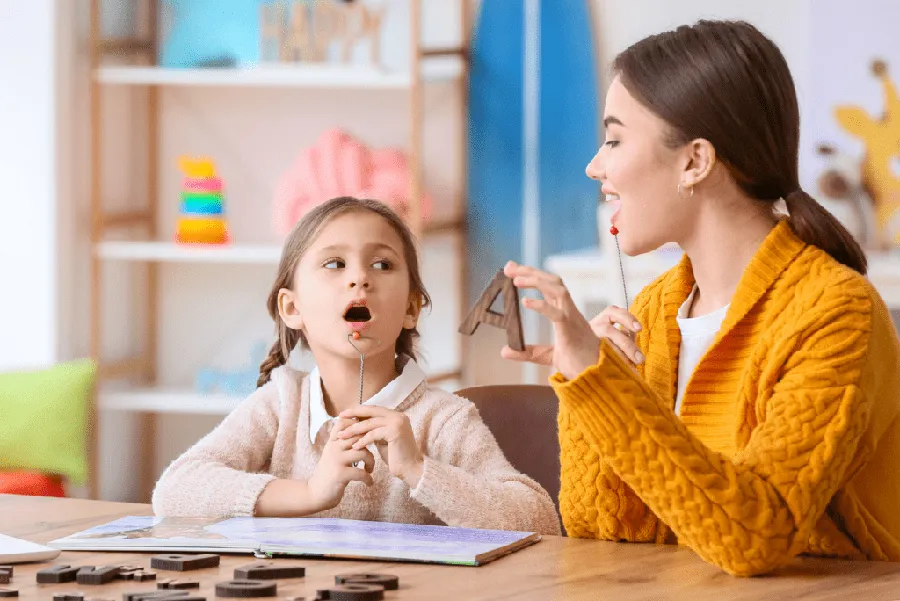
Therapy is kept child-friendly and practical. We use play, pictures, repeated language practice, and parent guidance so the child can use better communication at home, in school, and in everyday routines.
We look at what the child understands, not only what the child says, so therapy starts from the right level.
Sessions help the child grow vocabulary, use phrases, and communicate needs more clearly.
Parents are guided to use the same simple language strategies during home routines and play.
We assess understanding, vocabulary, sentence use, listening, and daily communication.
We begin with simple words, basic directions, and short phrase work based on the child's level.
The child works on using more words, better understanding, and clearer communication in activities.
Parents help the child use the same language skills during home routines, play, and school tasks.
Children often learn words, phrases, and understanding skills better when support starts early.
Early help can reduce crying, guessing, and stress when the child cannot explain needs clearly.
Language skills help with listening, following classroom instructions, reading, and learning.
When children understand and use more language, they often join play and interaction more confidently.
We keep language therapy practical, easy to understand, and focused on communication that families notice in everyday life.
Get a clear speech and language evaluation with a therapy plan that matches your child's needs.
Language delay means a child is slower to understand words, use words, or build sentences compared with what is expected for age. It can affect understanding, talking, or both.
Some children talk later than others, but if a child is using very few words, not joining simple words, or missing communication milestones, it is better to get an evaluation instead of only waiting.
Expressive language delay means the child has trouble using words, phrases, or sentences. Receptive language delay means the child has trouble understanding words, questions, or directions. Some children have both.
Yes. Speech and language therapy can help many late talkers by building vocabulary, sentence use, listening skills, and everyday communication. Progress depends on the child's needs and regular practice.
The number of sessions depends on the child's age, attention, goals, and how much home practice is possible. Children often improve better when therapy and home practice happen regularly.
Parents can talk during daily routines, name objects, read simple books, wait for the child to answer, and repeat or expand the child's words in a simple way. Short daily practice is often very helpful.